Lessons From an Old English Paper Pieced Quilt
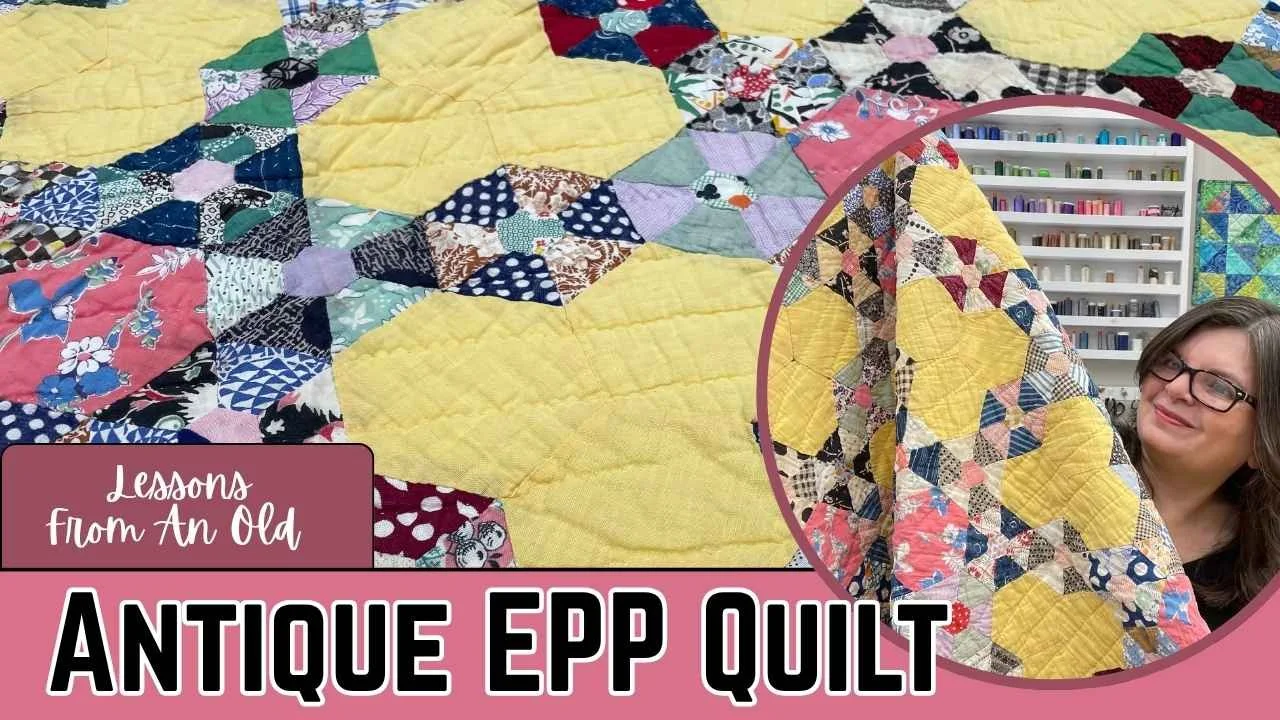
To watch the video, click HERE or on the image above.
About This Old Quilt
Details-At-A-Glance:
Size: 48” x 62” (throw or lap quilt)
Age: 1930s/1940s
Acquired: A viewer, Jill, sent this to me. She purchased it from eBay around 2013/2014 for $25.00
Quilt History: Jill mentioned in her letter that she used it for display until a few years ago. Since it was in storage and she didn’t see herself using it again, she graciously sent it to me.
Number of Pieces: If I counted correctly (I think I did), there are 879 pieces in the top of this quilt, not counting the binding and backing!
Construction Technique: I think this quilt English paper pieced by hand, although there isn’t any evidence of foundation papers.
Borders: There are borders on only three sides of this quilt.
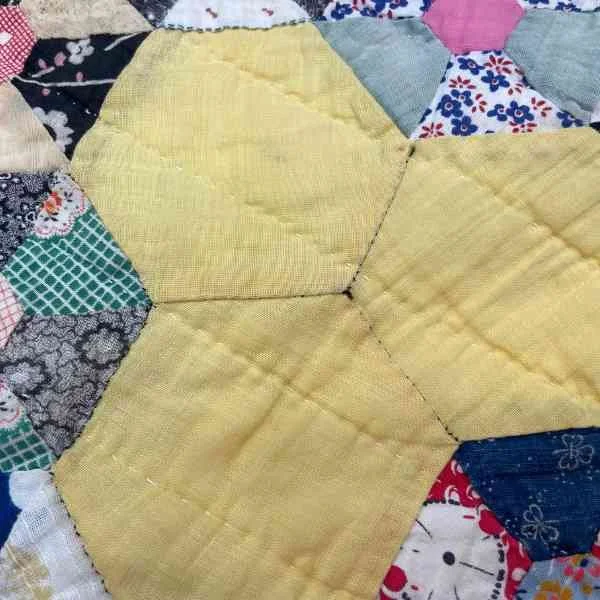
Quilting: Quilted completely by hand in a simple, yet effective, diagonal pattern
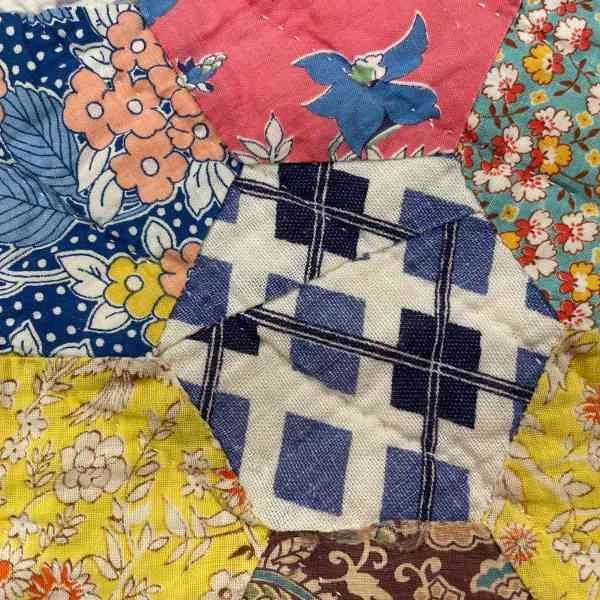
Fabric: Wonderful 1930s/1940s prints; all is cotton; one fabric is a bit heavier than the others
Batting: Cotton
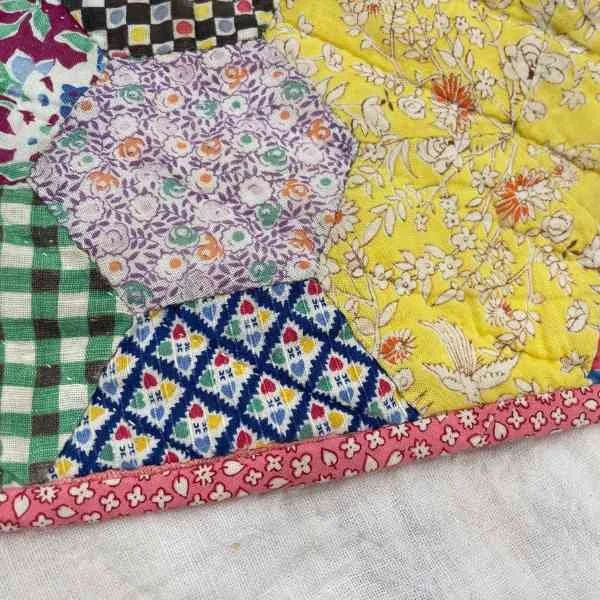
Binding: The binding was replaced beautifully by Jill with a new 1930s reproduction fabric. She used the same fabric to create a sleeve on the back. If you look closely, you can see some remnants of the original binding, which was also pink.
Backing: Muslin, pieced in the middle
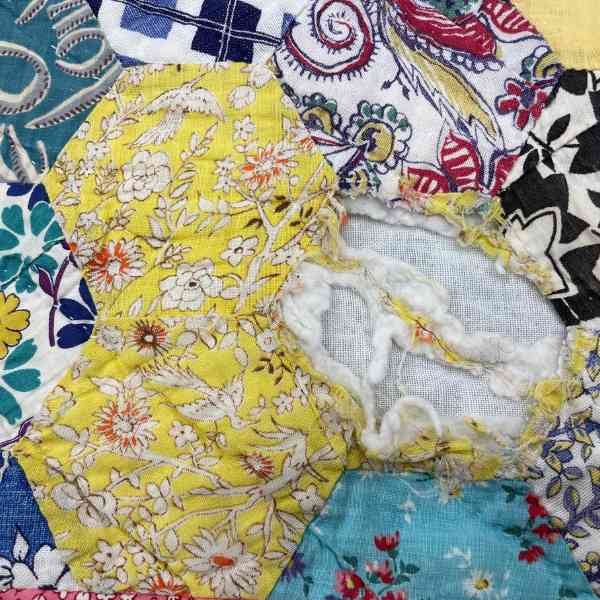
Condition: Good! This quilt does appear to be part of a bigger quilt because of the borders only being on three sides. We (Jill & I) both believe it was a larger quilt that was cut down. There are some areas where the fabric wore away over time.
Hexagon Blocks
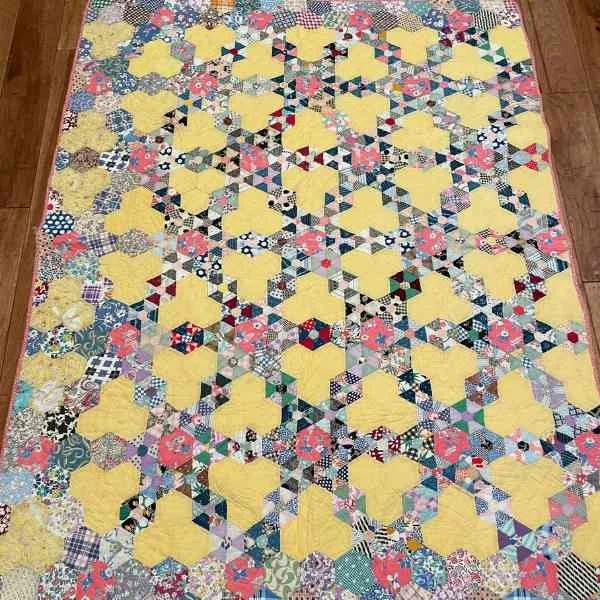
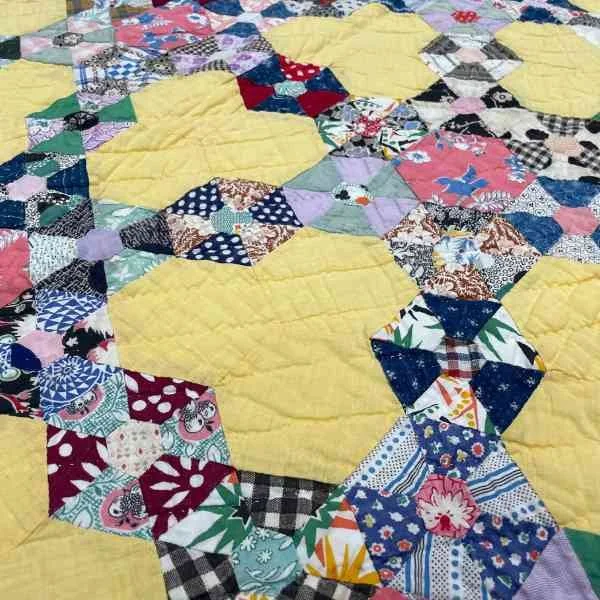
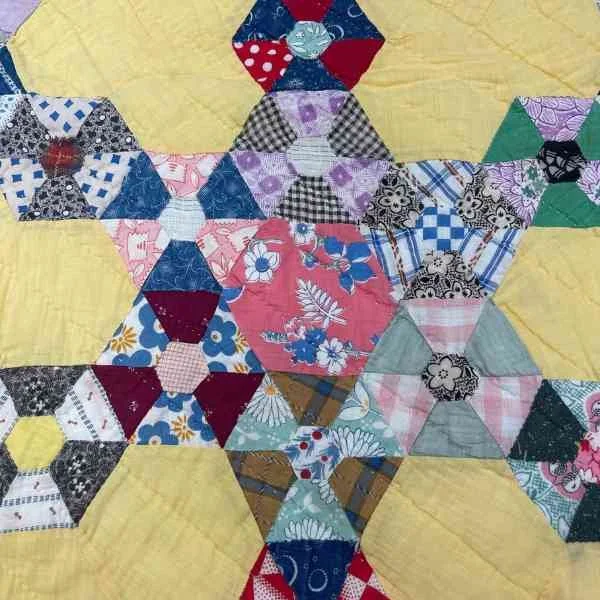
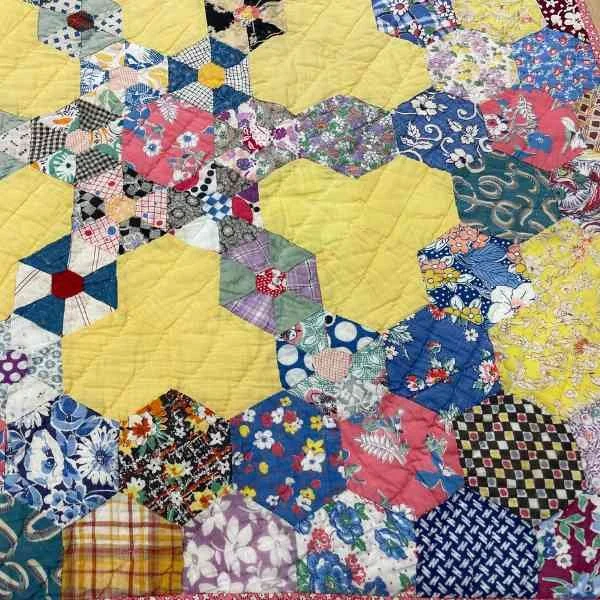
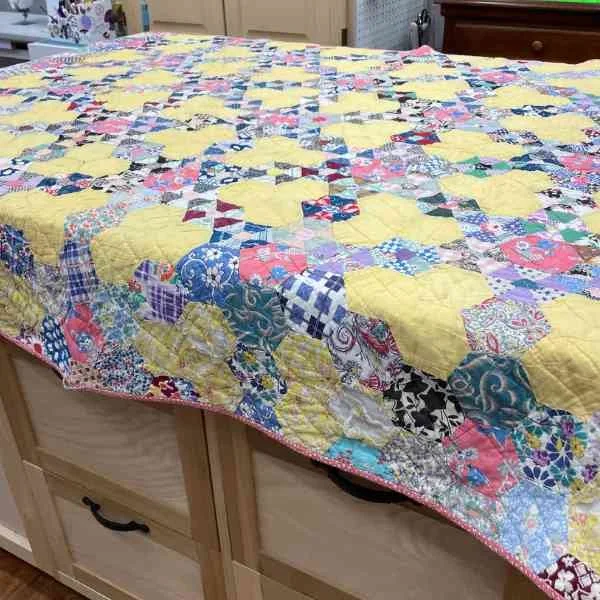
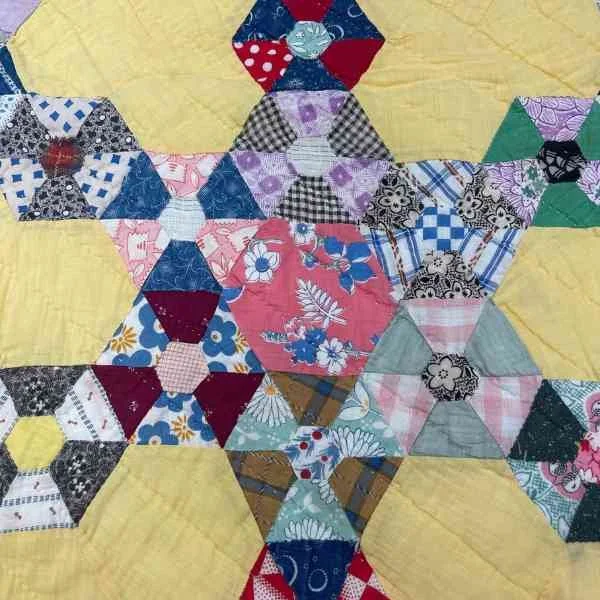
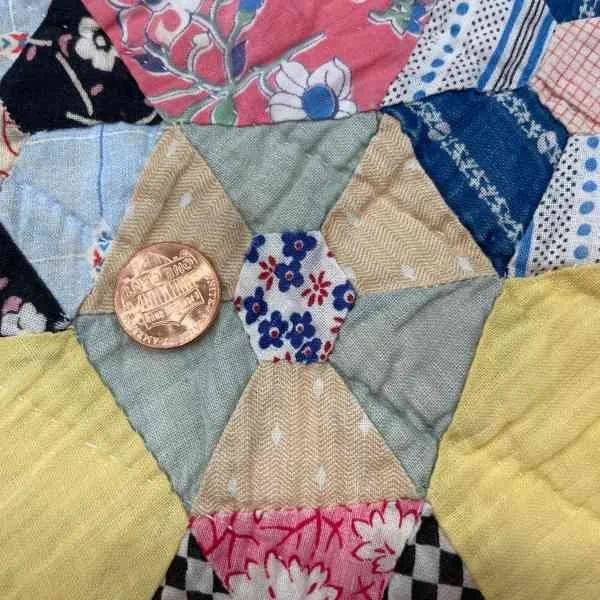
There are a lot of pieces in this quilt! If I counted correctly, there are 879 pieces in this quilt, not counting the binding, sleeve, and backing. Can you just imagine putting all of the pieces together by hand? Before we get started with the breakdown, I want to mention that hexagons are measured by the length of one side. Here’s a breakdown: Printed Large (1.5”) Hexagons: Prints: 109 full and 49 Partial in the borders; Yellow: 139 full and 5 partial. Small blocks: There are 79 of these blocks that contain 7 pieces. Each is made up of one ½” hexagon with six half hexagons (trapezoids) around the little hexagon, meaning there are 553 pieces (79 blocks x 7 pieces each = 553 pieces) in these alone. And that centerpiece is smaller than the size of a penny!
Tiny Hexagons
Let’s just take a minute and really appreciate the size of the smallest pieces in this quilt. Those little itty bitty hexagons in the center of the hexagon/half-hexagon units are only a ½” hexagon, and there are 79 of them in this quilt! They are each smaller than a penny. I am amazed by this.
Fabrics
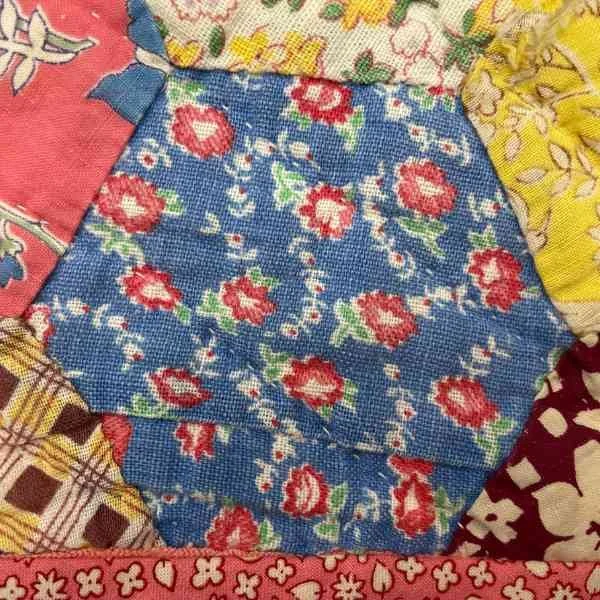
Although there are so many wonderful fabrics in this scrappy hexagon quilt, the solid yellow fabric anchors the design, and could be considered the star of the quilt (in a way) with the repeat of the pink centers (all the same print). All of the fabrics are cotton, with most of them (I believe) being feedsack fabric. There is one fabric that is a bit heavier than the others, but it is used sparingly in this quilt. All of the beautiful prints are fun to study and admire. I just love them all! There are plaids and dots and florals. Not to mention all of the wonderful colors, too!
Quilting
Quilting is all done by hand in a simple diagonal pattern. There are a few areas where the maker didn’t bury the quilting threads, which I just love, as you know if you have watched my other Lessons from an Old Quilt videos. The diagonal quilting gives this quilt a beautiful texture. Simple yet effective and beautiful.
Borders
There are borders on only three of the four sides of this quilt. That in itself is not unusual, especially in older quilts. It was fairly common for makers to omit the border at the top of the quilt since this is the side that would sit at the head of the bed. However, this quilt tells a slightly different story. The three borders appear on both short sides and on just one of the long sides. That arrangement raises a bit of a mystery. Both the previous owner and I believe the quilt was originally larger and was cut in half somewhere along the way. This would neatly explain why only three borders remain.
Backing, Batting & Binding
Let’s start with the binding: If you look super closely, you can see the original binding underneath the new binding, which was put on by the previous owner. She made sure to replace it with a pink fabric, since that is the original binding color. She also made a hanging sleeve for this quilt out of the same pink fabric. I love that she repaired it in this way. It is a wonderful way to honor the maker! The backing is a basic muslin. It is pieced in the middle. The batting is cotton, as you can see in the picture. I
Condition
There are some minor stains from age and some of the fabrics didn’t hold up as well as others, but overall, it is in great condition considering its age. This quilt still has a lot of life in it and with some minor repairs, it will be as good as new. Speaking of repairs, there are a few places where someone did repair it. One area is zigzag stitched. Because this quilt is colorful and, well, busy, it is hardly noticeable, however.
Lessons We Can Learn
What can we, as modern makers, learn from this old quilt?
Consistent Elements = Continuity in the Quilt: The yellow and pink fabrics act like an anchor for this quilt, and allows for all the other scraps to come in and play together nicely. I love this element in a quilt.
Consistency in Each Build Hexagon: Along with the consistent colors, there is consistency within the other scraps, too. Within the pieced hexagons, there are three fabrics: the center, three “spokes” or trapezoids of one fabric; and three “spokes” or trapezoids of another fabric. They all contrast well and give a wonderful look to this quilt.
Simple Diagonal Quilting: Many times makers like to shadow quilt around hexagons, which is great and beautiful. For this one, however, the maker decided to quilt this in a simple diagonal pattern. I’d like to think that they weren’t overthinking (something I would definitely do!) and just went with it, but something tells me it was planned. If the maker did quilt around each piece, the quilting wouldn’t have been very noticeable at all. Work smarter not harder, perhaps?
Borders on Three Sides: This is probably a quilt that was cut down, BUT it looks really cool! What if it was on purpose? It gives a great look to this quilt, doesn’t it? We could do this with quilts that we want to repurpose, or even make a quilt like this on purpose to leave future generations wondering what exactly happened. Hahaha!
Repeating Elements in the Borders: I love that the yellow fabric carries into the borders. Again, this maker worked consistency into many elements of this design.
Thank you so much for reading about this beautiful old quilt.
Kris