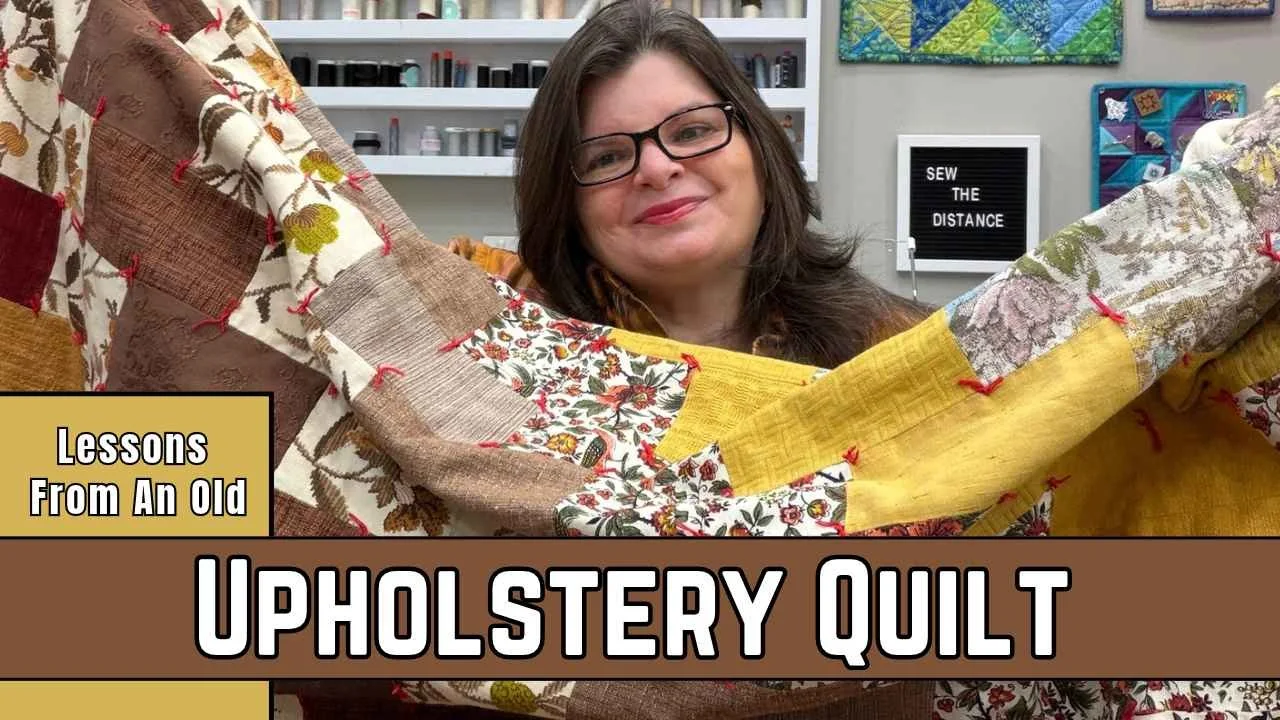
To watch the video, click HERE or on the image above.
About This Old Quilt
Details-At-A-Glance:
Size: 83” x 94”
Age: 1960s/1970s
Acquired: I bought this quilt from a yard sale for $10.00. I wasn’t going to buy it, but my mom talked me into it. When I got it home, I was glad she did!
Quilt History: The sellers didn’t know anything about it, unfortunately.
Number of Blocks: 363 full bricks and 24 partial bricks for a total of 387 bricks; each brick measures 3.25” x 6.25” finished
Construction Technique: Machine pieced
Quilting: The quilt is tied with red embroidery floss.
Fabric: The top is completely made from heavy-weight upholstery and home decor fabrics.
Batting: There is something in there, but it is hard to tell what it is. It may be another piece of upholstery fabric.
Binding: Pink satin or possibly silk binding; it was attached by machine to the front and finished by hand onto the back
Backing: Unexpected bright red paisley print
Condition: Excellent! No holes or tears at all.
Overall Design & Construction
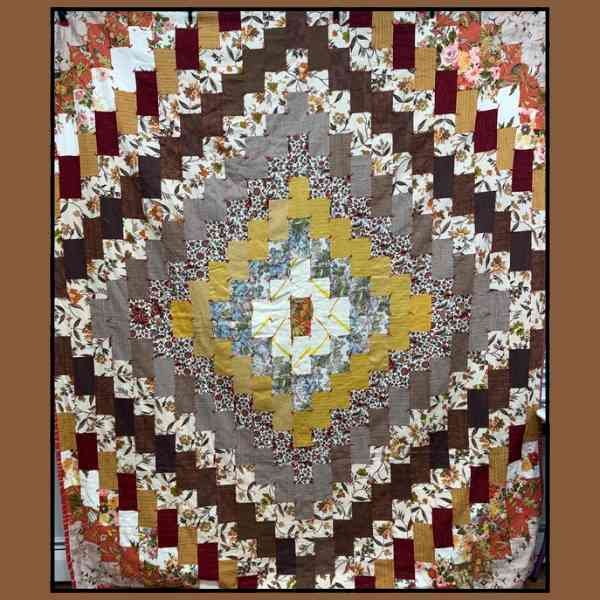
Traditionally, we see Trip Around the World quilts made with squares, but this one is made with rectangle “bricks” that measure 3.25” x 6.25” (finished). This creates an elongated diamond medallion with a wonderful ripple effect. This particular quilt has 363 bricks and 24 partial bricks, with a total of 387 bricks on the front of this quilt. The quilt measures 83” x 94” and weigh almost 10 lbs. It is a thick heavy quilt with some much character!
Value & Contrast
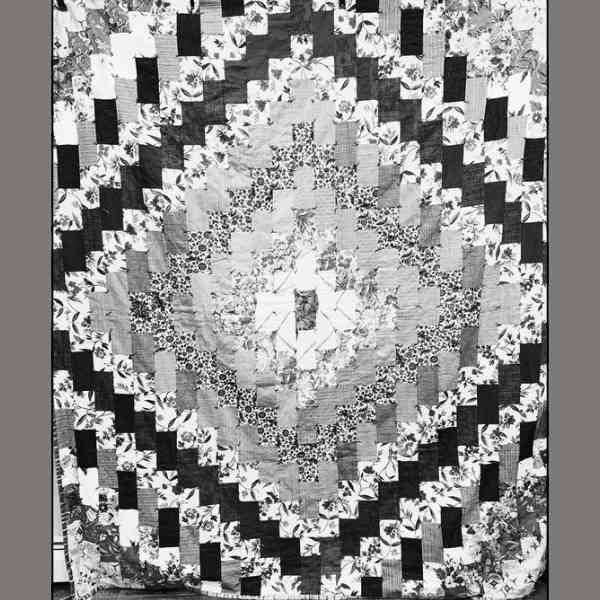
The overall pattern really shows when we look at this quilt with a black and white filter. You can see that the center isn’t as contrasted as we would think by looking at quilt in color. Interestingly, the dark “trip” or path around really shows up, giving it a wonderful frame.
Fabric
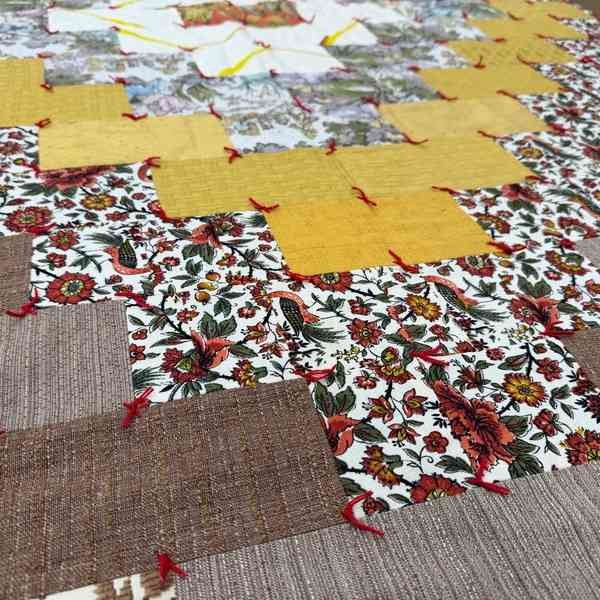
The front of this quilt is made up of heavy-weight upholstery fabric, with a lot of it being barkcloth, vintage jacquards, and more. Most of these fabrics remind me of something you would see on a couch in the 1960s/1970s. The maker did a wonderful job with the color value on this one. Although every “trip around the world” doesn’t contain the same fabrics, the colors blend well together giving it an overall cohesive look.
Backing and Binding
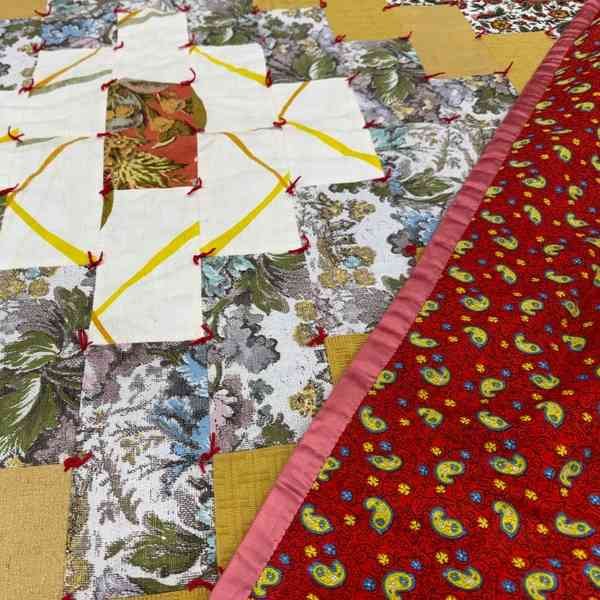
Even though this quilt is mostly yellows and browns, there are some hints of red and pink in the prints. Maybe that is why the maker decided on two bold choices for the backing and binding. The backing is a bright red cotton paisley print. The binding is the most surprising element, in my opinion. It is bright pink silk. Interesting choice! The binding is sewn to the front, wrap around, and hand-stitched to the back.
Ties
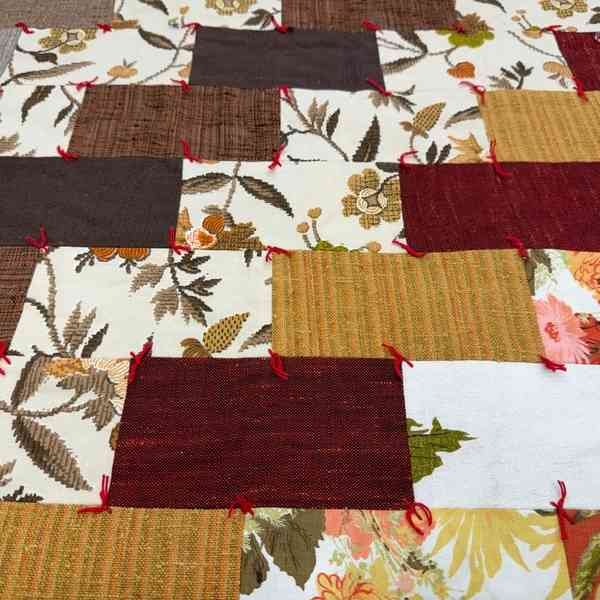
This quilt is not quilted, but tied with red embroidery floss. There are some reds on the front of this quilt, but I think (this is a guess) the maker wanted to match it to the backing fabric so the tied blended in on the back of the quilt. It really is anyone’s guess, however. Another interesting thing is that the ties are on seams and not in the middle of blocks like you traditionally see them. Ties are evenly space and have done a great job holding this quilt together.
Pieced Blocks
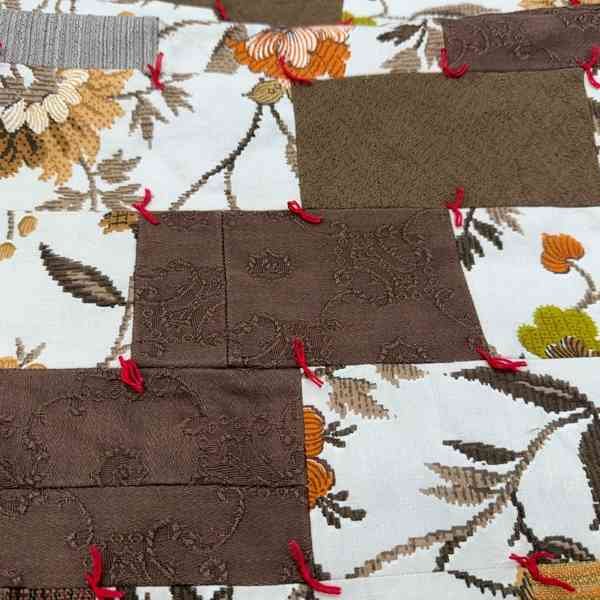
We see this many times in the old quilts, the maker pieced together units to make the blocks. I always love seeing this because it is a wonderful reminder that we can do the same thing. It doesn’t take away from the quilt at all; in fact, you could argue that it actually adds to the quilt.
Lessons We Can Learn
What can we, as modern makers, learn from this old upholstery quilt?
Non-Traditional Fabrics: I just love that the maker used non-traditional fabrics to make this quilt. I love imagining how this came about. Did they work at a furniture store? A fabric manufacturer? Were these samples of some sort? Remnants? And why use satin or silk binding to bring it together? Is the juxtaposition of the soft textures and the hard textures? I would love to know.
Mixing Colors: It is so interesting how the maker mixed colors, but in an organized way. For example, for one of the paths, the maker alternated brown and maroon. This is a great way to make limited fabric work. So smart!
Use of Large Prints: As many of us know, using fabric with a large-scale print can be tricky. If the print isn’t in the right placement in a piece, the block can look like it is the background fabric, in this case, off-white.
Piecing Blocks: Some of the bricks are pieced together to make them large enough. Matching patterns is the best way to do this, but it does require extra fabric, which isn’t always available. Does it really matter? Sometimes yes, but sometimes, like in this quilt, no. You can’t really see it unless you really study it.
Tying on the Seams: I am not sure if I would have recommended this before seeing this quilt. I would think it would put too much stress on the seams, but as we can see in this one, it didn’t. It could be because it is made of heavy fabrics. Another area to consider is the spacing. The ties on this quilt are evenly spaced and there are a lot of them, allowing the fabric heavy to be evenly distributed.
Thank you so much for reading about this beautiful old quilt.
Kris